Guide
SWING: The Art of Movement in Stillness
SWING translates the rhythm of dance into sculptural bathroom design. Discover how rotating forms, conical geometry, and graphic black-and-white lines give the MonBlari collection a sense of movement in stillness.
A turn of the shoulders. A shift in balance. A gesture held for a moment before the next movement begins.
Dance gives familiar shapes an unexpected energy. For designer Hui Wang, that energy became the starting point for SWING, a bathroom collection by MonBlari that explores movement through geometry.
Drawing on impressions from her time in Italy and the memorable dance scene in Quentin Tarantino’s Pulp Fiction, Wang translated the spontaneity of movement into sculptural forms. Rotation, proportion, and graphic lines give the collection a distinctive presence—even when everything is perfectly still.
 From Dance to Design
In Pulp Fiction, the dance between Vincent Vega and Mia Wallace has an informal, playful rhythm. Small gestures and changes in posture give the scene its character.
For SWING, this sense of movement became a question of form: how could an everyday object suggest a turn, a pause, or a shift in balance?
The answer developed through geometry. A familiar shape could be tilted, divided, or brought into contact with another volume, creating a silhouette that feels poised between one position and the next.
The resulting design carries something of a dancer’s changing posture. Its character comes from the relationship between its parts and the way those relationships change as the viewer moves around it.
Geometry in Rotation
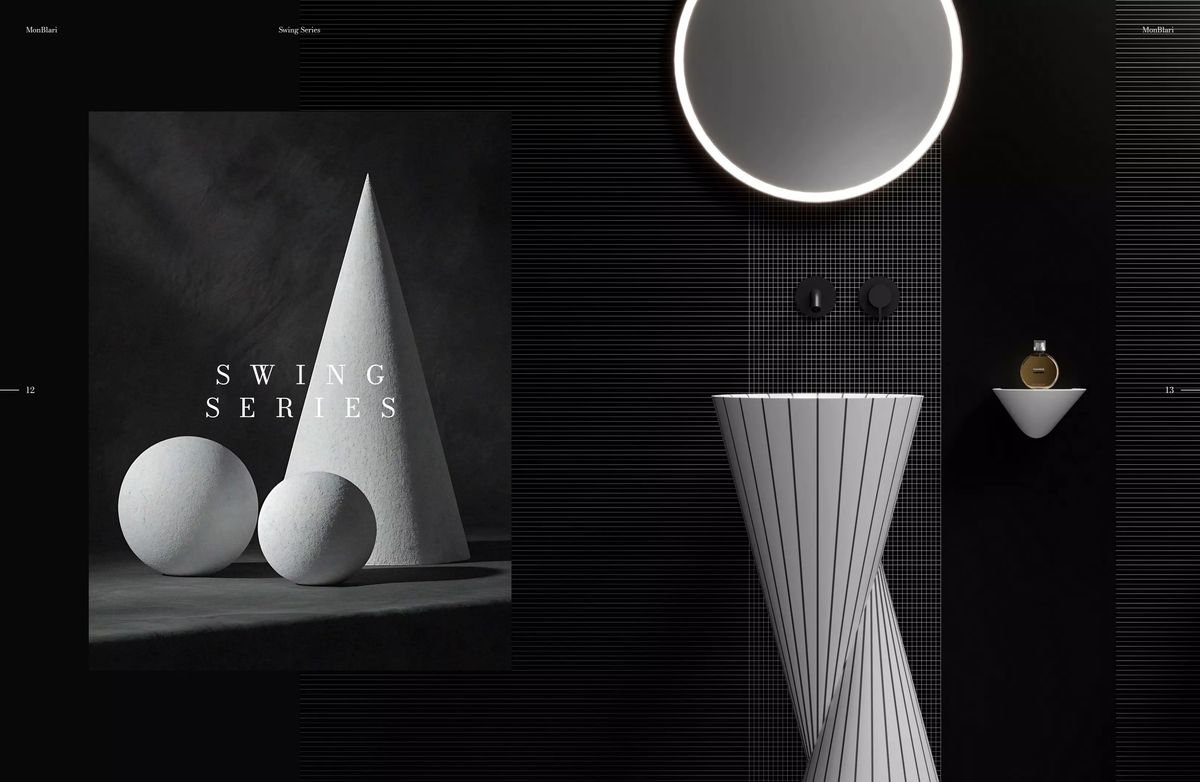
The cone forms the basis of SWING’s sculptural language.
Cutting, rotating, and combining conical volumes creates a composition that appears to twist around its axis. The narrowing and widening profiles give the eye a direction to follow, while the meeting points between surfaces introduce changes in rhythm.
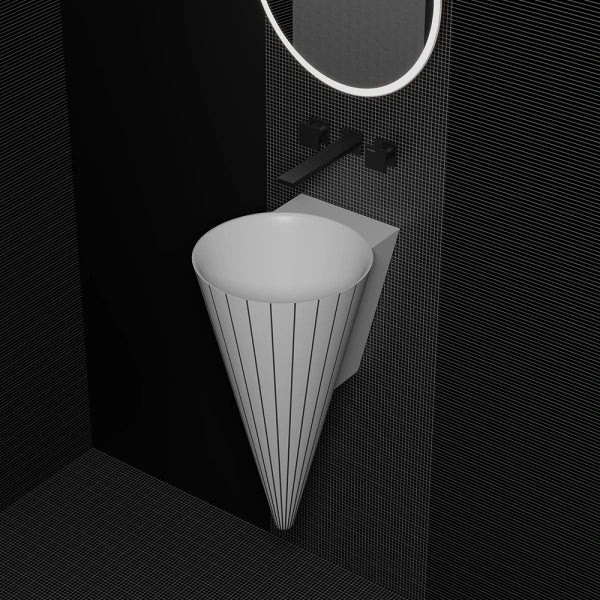
The freestanding sink expresses this idea particularly clearly. Rising from the floor, its silhouette has the presence of a small sculpture. From one angle, the form feels composed and symmetrical; from another, its shifting volumes become more apparent.
This changing perspective is central to the design. Walking past the piece reveals a different arrangement of curves, edges, light, and shadow. Movement belongs as much to the experience of looking as it does to the shape itself.
 Lines That Give the Form Direction
On the collection’s striped designs, fine black lines follow the contours of the white body, emphasizing its changing proportions.
The lines guide the eye across the surface. As the form narrows, widens, or turns, the pattern makes those changes easier to perceive. Geometry and decoration work together, giving the impression of rotation a more visible rhythm.
This relationship also makes precision important. The continuity and placement of each line influence how the overall pattern is read, particularly where the surface changes direction.
Viewed from a distance, the black-and-white contrast creates a clear graphic identity. Up close, attention shifts to the way the detailing follows the underlying form. Both views contribute to the character of the piece.
A Collection with Different Expressions
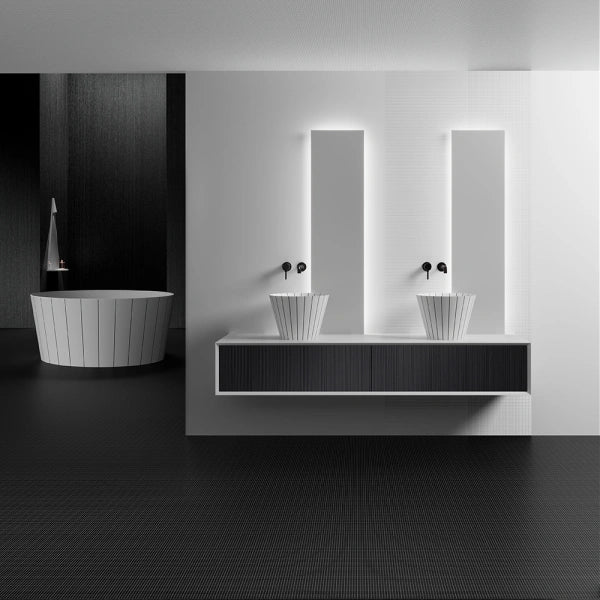
SWING carries its design language across sinks, bathtubs, bathroom furniture, and coordinating accessories.
The pedestal sink gives the twisting geometry a vertical expression. Countertop and wall-mounted sinks bring related forms to different arrangements, allowing the collection’s character to work at a smaller scale.
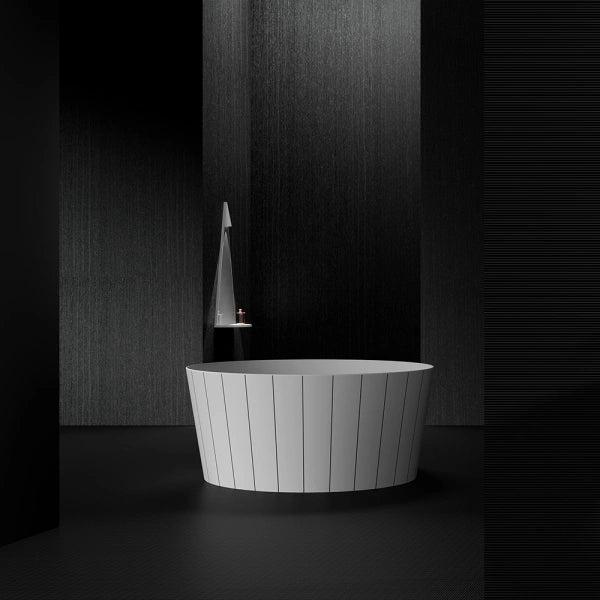
The bathtubs introduce broader curves and a more substantial presence. Their shapes establish a focal point around which the rest of the bathroom can be arranged.
Coordinating cabinetry, mirrors, and accessories offer further connections through proportion, texture, and shape. Each piece contributes differently; the collection does not depend on every object repeating the same silhouette or striped finish.
That variety allows SWING to work as a single statement piece or as part of a more connected bathroom composition.
 Finding Balance in the Room
A sculptural object benefits from enough space for its outline to be understood.
With SWING, a restrained backdrop can make the changing geometry more visible. Plain wall surfaces and considered lighting allow the curves and graphic details to establish their own rhythm.
A striped sink might become the room’s main point of interest, supported by quieter surrounding finishes. Alternatively, several coordinating pieces can create continuity across the bathing and washing areas.
The idea behind SWING remains present in either approach: a static object can suggest the energy of a gesture.
Through rotating volumes and carefully directed lines, the collection brings a sense of movement into the everyday bathroom—something to notice from a new angle, each time you enter the room.